Off-the-shelf or custom software? A decision guide to choosing a booking system
We compared an off-the-shelf booking system with custom software on cost items, flexibility, data ownership and maintenance. Concrete questions and a short decision list for transfer, tour and clinic businesses.
Off-the-shelf or custom software is a decision every tourism business choosing a booking system faces at some point. Whether you are a transfer company, a tour operator or a clinic, the wrong choice leads either to a team struggling with spreadsheets and phone calls or to a heavier project than you need.
In this guide we compare the two approaches on cost, flexibility, data ownership and maintenance, and list concrete questions to help you decide. We can look at the topic from both sides: we run custom software projects for businesses, and our SaaS product Turion, which we built for transfer and tour businesses, has been in use by our first customers since 2023. If you would like to look at tourism websites as a whole, take a look at our website guide for tourism businesses.
The difference between the two approaches
Off-the-shelf software is a product that a provider develops once and opens up to many businesses. Today most off-the-shelf booking systems are offered as SaaS (software as a service), that is, on a monthly or yearly subscription; in this model the provider hosts and updates the system. Packages installed on your own server under a licence and ready-made booking plugins added to your site are off-the-shelf software too. Because SaaS is so widespread, “SaaS or custom software?” is the most common way this comparison is put.
Custom software, on the other hand, is a system designed and developed around your workflow. Screens, rules and reports take shape around how your team really works. The core of the comparison is this:
- Getting started: An off-the-shelf system is set up quickly; custom software needs a discovery, design and development process.
- Flexibility: With an off-the-shelf system, the provider decides the features; with custom software, you set the priorities.
- Cost structure: With an off-the-shelf system you usually pay a regular subscription or licence fee; with custom software there is an initial investment and a maintenance cost.
- Control: With an off-the-shelf system, the roadmap belongs to the provider; with custom software, you decide the system’s future.
- Maintenance: With an off-the-shelf system, the provider prepares updates and, in SaaS, applies them itself; custom software needs a maintenance plan for security updates, backups and monitoring.
When is an off-the-shelf booking system enough?
If an off-the-shelf package fits most of your business, it is often the lowest-cost path. An off-the-shelf booking system is usually enough when:
- Your sales and booking process looks like the common flow in your sector.
- You work with a small number of products, routes or services.
- Your need for connections to other systems is limited.
- You want to start quickly and see the demand first.
- You do not yet have a budget or a team to manage and develop the system.
Before you choose an off-the-shelf system, act out a real day of yours from start to finish in the trial version. Take a booking, change it, cancel it and pull a report. Every step where you get stuck may become a problem your team faces every day later on. Also ask the provider about its support channels, how it responds when a problem comes up mid-season and how it announces price changes.
When do you need custom booking software?
The clearest sign is this: if your team turns to spreadsheets, email and the phone to cover the gaps of an off-the-shelf system, the time lost quietly turns into a large cost. In tourism, this line usually becomes clear at three points.
Driver assignment in transfers
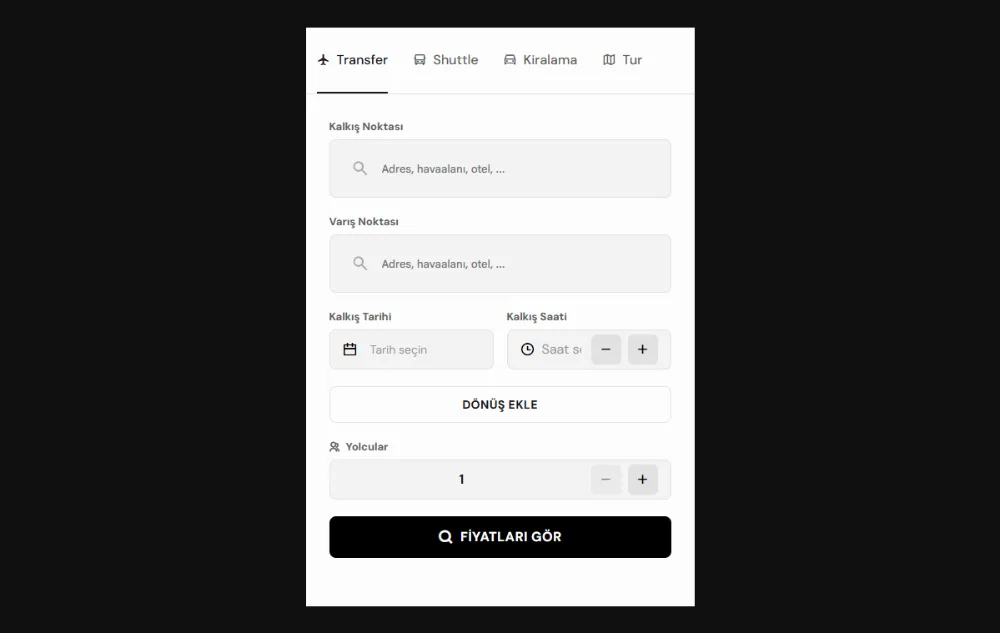
For a transfer company, taking the booking is only the start; the real load is assigning vehicles and drivers by flight time, tracking delays and putting together the day’s list. If prices by area and vehicle type, transfers from agencies and the driver screen do not come together in the same system, the team prepares the list by hand every morning. We describe these needs in detail in our solutions for transfer companies; for the side of the site that guests see, take a look at our article on what a transfer company website should have.
Availability in tours
For a business that sells tours, the biggest risk is selling the same seat twice. If availability runs out on the site, at hotel receptions and with sub-agencies at the same time, every channel needs to feed from a single allotment. When guide and vehicle planning, seasonal prices and sub-agency commissions come into play as well, test carefully whether the off-the-shelf system fits these rules. We cover these topics on our tour operator software page.
The patient journey in health tourism
In health tourism, the process is not a single booking but a journey from the first message to the follow-up. The request, initial assessment, treatment date, accommodation, airport transfer and follow-up appointment should come together in the same patient record. We describe how this journey looks on the website in our health tourism website guide.
The hybrid model: an off-the-shelf core with custom parts
The choice is not always all or nothing. In a hybrid model, you use an off-the-shelf solution for the standard part of the work and have the part that sets you apart developed for you. A few examples:
- Off-the-shelf services for payments, accounting and e-invoicing, with a custom panel for the booking and operations flow
- Custom modules that add screens and reports specific to your business on top of an off-the-shelf CRM
- Integrations that bring the data of an off-the-shelf booking system into your own site and panel
A hybrid model does not always mean writing custom code either. If the system you use carries the standard part of the work well, consider strengthening the work around it before you have it rewritten: arranging the screens for their users, business email, backups and regular maintenance, for example.
For Ertekbayi, the B2B brand through which Ertek Bilgisayar offers camera, alarm, cable and installation products to registered dealers, we provide IT and interface consultancy, business email, cloud and monthly maintenance services. Through consultancy on the interface design of the B2B store, we placed the current exchange rate in the header, dealer login and account transactions at the top of the menu, and the stock code and stock quantity on every product card. We moved the company’s business email to Google Workspace and set up regular backups on the cloud infrastructure. Every month we continue the maintenance that reports on backup, update, security and performance checks, together with IT consultancy. You can find the details on the Ertekbayi project page.
We keep this flexibility in customer, sales and operations systems too: we adapt an existing structure to your business or, if your needs call for it, build the system from scratch. You can find the details on our CRM and ERP systems page.
Total cost items
When you compare the two paths, do not look only at the first quote or the monthly fee. To see the total cost over a few years, write these items side by side.
With an off-the-shelf system:
- The subscription or licence fee, and extra charges per user or per transaction
- The yearly total of any commission charged per booking
- Add-on modules, extra languages and moving up to a higher plan
- Setup, data migration and team training
- The development needed to connect with your other systems
- Moving your data if you want to leave the system later
With custom software:
- Discovery, business analysis and design
- Development and testing
- Server, domain and the third-party services used
- Security updates, backups and maintenance
- New features added over time
Add one more item to the list: the time your team spends on manual work. Bookings copied into spreadsheets every day and details confirmed by phone are a cost that never appears on an invoice but is paid every month.
Data ownership and export
The customer list, past sales and price structure in your booking system are among your business’s most valuable assets. Whichever path you choose, make clear who holds this data before you sign a contract. Ask the provider or agency these questions:
- In what format and how often can I export my data?
- When the contract ends, how is my data handed over to me, and when is it deleted?
- In which country and on which server is the data kept, and how does it comply with KVKK (the Turkish Personal Data Protection Law)?
- With custom software, in whose name will the source code, the domain and the server accounts be?
- If another team wants to take over the system, are the documents and access details ready?
The answers to these questions should be written into the contract. We have gathered the other topics to ask about when you work with an agency in our article on 10 questions to ask when choosing an agency.
Off-the-shelf or custom software: a short decision list
Find the line closest to your situation; the suggestion next to it shows which question to take to the discovery call.
- Your process is standard, your team is small and you want to start quickly: an off-the-shelf system.
- An off-the-shelf system fits most of your business, with a few gaps: an off-the-shelf system with custom integration, in other words the hybrid model.
- Your team covers the gaps with spreadsheets and phone calls every day: consider custom software seriously.
- You have rules specific to your business, such as driver assignment, availability or the patient journey: custom software or a strong hybrid model.
- Full control of the data and the system is a priority for you: custom software with a written ownership clause.
- You are not yet sure what you want: get to know the demand and the process with an off-the-shelf system first, then decide.
Car Clinic: customers, vehicles and accounting in one system
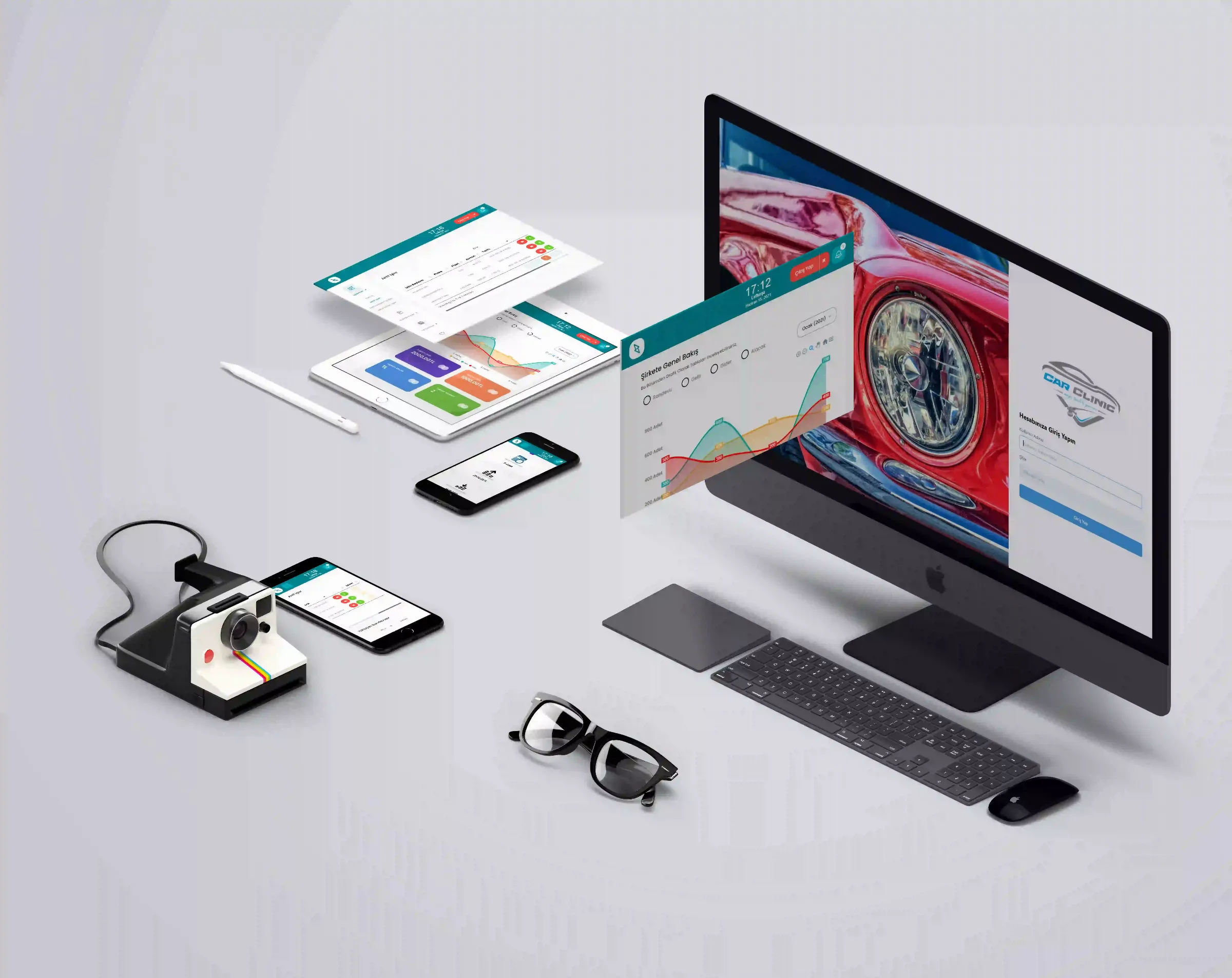
Let us look at when custom software makes a difference with an example from outside tourism. For Car Clinic, which provides vehicle maintenance and repair services in Cyprus, we developed a CRM that runs from customer management to accounting and works with the same data on the web, desktop and mobile.
The service adviser creates the customer and their vehicle in a single record; the number plate, chassis number, mileage and contact details go into this card, and every later visit is added to the same card’s history. Vehicles with maintenance, inspection or insurance dates coming up stand out in the reminders list, and the adviser sends the customer a reminder and adds the appointment to the calendar from the same screen. In the accounting module, a service job becomes an invoice and the invoice becomes an entry on the customer account; income, expenses and receivables are followed with monthly charts.
The point that matters for the decision is this: if the customer record, reminders and accounting sat in separate off-the-shelf tools, the same customer’s details would be entered in three places and updated in three places with every change. One record means the information is entered once and the reminder goes to the right person at the right time. Because the system works with the same data in the web browser, on desktop and on mobile, the team also sees the same record whichever device they use. If you cannot find an off-the-shelf system that brings the parts you need together in one record, that is a strong reason to consider custom software.
The same question applies in tourism: do bookings, customer records, reminders and payments come together in one place? The patient journey in health tourism and driver assignment in transfers can be designed with the same logic. You can look at the screens on the Car Clinic project page.
Frequently asked questions
Can you move from an off-the-shelf system to custom software later?
Yes, but how easy the move is depends largely on whether you can export your data. When you choose an off-the-shelf system, make sure you can export customer, booking and payment records regularly. Planning the move outside the season also gives your team time to get used to the new system.
Who should hold the source code and the data?
The data should always belong to your business and be exportable whenever you want. With custom software, have the contract state in whose name the source code, the domain and the server accounts will be. With an off-the-shelf system the source code stays with the provider, so the right to export data matters even more there. In our custom software projects, access to the source code, the domain, the server and third-party accounts is handed over to you on delivery.
Is a monthly fee expensive in the long run?
It depends. If you work with few users and a standard process, a subscription can stay reasonable in the long run too. If the fee grows as users, transactions or commission grow, compare the total over a few years side by side with the development and maintenance cost of custom software.
What is the hybrid model?
The hybrid model means using off-the-shelf solutions for the standard part of the work together with custom-built modules for the part specific to your business. For example, off-the-shelf services can be used for payments and accounting while the booking and operations flow is built for you. This approach lets you set up a system that suits your business without developing everything from scratch.
Let’s choose the right path together
It is hard to say which path suits you without seeing your business. In custom software projects, we compare both paths openly in the discovery call, and if an off-the-shelf solution meets your needs, we tell you that too. To talk about your project, you can fill in the quote form.